%2520(1).jpeg)

You're about to invite a stranger into your parent's home to help with the most personal parts of daily life: bathing, dressing, meals, medications. The brochure will tell you every agency is compassionate and trustworthy. The questions below will tell you which ones actually are.
Ask all seven. Write down the answers. Compare agencies side by side. The differences will surprise you.
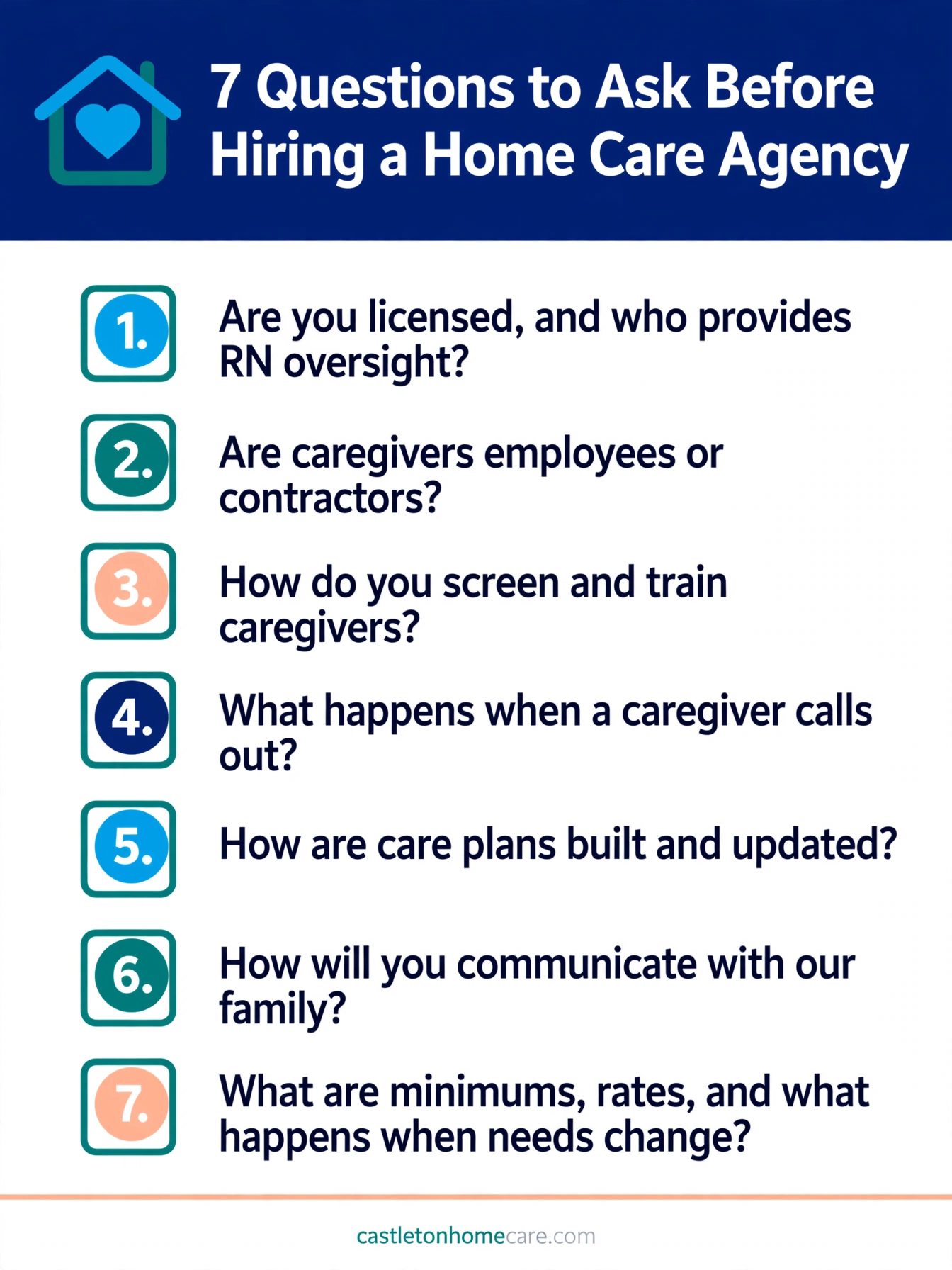
1. Are you licensed, and who provides RN oversight?
What you're really asking: Is this a real agency accountable to the state, or just a name and a phone number?
In Georgia, legitimate home care agencies are licensed by the Georgia Department of Community Health as Private Home Care Providers. Ask for the license number. (Ours is PHCP013166.) Then ask who oversees care quality. A registered nurse should be involved in assessments, care plans, and caregiver supervision. If the answer is vague, or if there's no nurse involved at all, that's a meaningful gap. RN oversight is one of the clearest lines between a professional agency and a casual operation.
2. Are caregivers employees or contractors?
What you're really asking: Who is actually responsible for the person in my parent's home?
This is the question most families never think to ask, and it matters enormously. If caregivers are W-2 employees of the agency, the agency handles background checks, training, payroll taxes, workers' compensation, and liability insurance. If they're independent contractors or "referrals," many of those responsibilities may quietly fall on you, including tax and liability exposure you didn't sign up for.
A good answer: "Our caregivers are our employees. We handle all of that."
3. How do you screen and train caregivers?
What you're really asking: Who exactly are you sending to my mother's house?
Don't accept "we thoroughly vet everyone." Ask specifics: background checks (what kind, and how recent?), reference checks, skills assessments, and what training looks like both before the first shift and ongoing. Ask whether training covers the situations your family actually faces: mobility assistance, personal care, communication with families, and what to do in an emergency.
Also ask how matching works. The best agencies don't just fill a slot; they consider personality, experience, and your parent's preferences when pairing a caregiver with a family.
4. What happens when a caregiver calls out?
What you're really asking: Will my parent be left without help on a Tuesday morning?
Caregivers get sick. Cars break down. Life happens. The question is whether the agency has a real backup system or just hopes for the best. Ask: do you have backup caregivers available? How quickly can you cover a missed shift? Who do I call, and will someone actually answer?
An agency with a bench of trained, agency-employed caregivers can cover a callout. An agency that scrambles is telling you something about how thinly it's staffed.
5. How are care plans built and updated?
What you're really asking: Is this personalized, or am I buying generic hours?
A proper care plan starts with an assessment: an in-home or virtual visit where someone qualified learns about your parent's needs, routines, preferences, and home environment. The plan should be written, specific, and shared with you. And it should evolve. Needs change, sometimes gradually, sometimes overnight after a hospital stay. Ask how often plans are reviewed, who updates them, and whether the RN is involved when needs shift.
Be wary of any agency that wants to start service without an assessment. That's not efficiency; it's guesswork.
6. How will you communicate with our family?
What you're really asking: Will I know what's happening in my parent's home when I'm not there?
This matters most for adult children managing care from a distance. Ask: will I get updates after visits? Is there a care log I can check? Who do I contact with concerns, and how quickly do they respond? Is there one consistent point of contact, or am I calling a general line and explaining myself every time?
Good communication is a system, not a personality trait. Look for agencies that can describe theirs concretely: visit notes, a dedicated contact, and a clear escalation path when something seems off.
7. What are minimums, rates, and what happens when needs change?
What you're really asking: What will this actually cost, and am I locked in?
Get the numbers in writing: the hourly rate range, any minimum hours per visit or per week, and what triggers a rate change. Our typical rates range from $30–$40 per hour with a 4-hour minimum per visit and a 12-hour weekly minimum, and you'll find the full breakdown on our pricing page. Whatever agency you're evaluating should be equally direct.
Then ask about flexibility. Can hours increase if needs grow? Can they decrease? Is there a long-term contract, or can you adjust the schedule? Life with an aging parent is unpredictable; your care arrangement should bend without breaking.
A Few Red Flags Worth Noting
You don't need us to tell you to trust your gut, but a few patterns are worth naming:
- They won't put rates in writing. Vague pricing now means surprise pricing later.
- No license number, or they dodge the question. In Georgia, this is non-negotiable.
- They can't describe their backup plan. See question 4.
- High-pressure tactics. "We need a decision today" has no place in a decision this personal.
- They badmouth competitors by name. Confident agencies sell their own standards.
None of these alone is proof of a bad agency, but together they're a pattern. Keep looking.
The Bottom Line
The right agency will welcome these questions. In fact, the best ones will answer most of them before you finish asking, because they've built their whole operation around the answers.
When we get in touch, we'll take the time to personally understand your unique situation and offer solutions that fit. Call us at 770-810-5974 or reach us through our contact form, and bring your toughest questions. We like those.
Disclaimer: The information in this article is provided for general educational and informational purposes only and is not intended as, and should not be taken as, medical, nursing, legal, financial, tax, or insurance advice. You should consult with qualified professionals—including, but not limited to, a doctor, attorney, financial planner, or tax advisor—for guidance specific to your situation. Castleton Home Care does not guarantee the accuracy, completeness, or timeliness of the information contained in this article and assumes no liability for any actions taken based on its contents.
.jpg)

.jpg)