

The Short Answer
The holidays bring families home, and coming home is often when adult children first notice that something has changed. Dad moves a little slower than he did at Easter. Mom's fridge looks emptier than it should. The house that was always spotless has a stack of unopened mail on the counter. None of it is an emergency on its own, but together it tells a story, and the holidays are when that story finally gets heard. This guide covers what to watch for during a holiday visit, how to keep things steady for a parent whose memory isn't what it used to be, how to plan coverage while offices and caregivers run holiday schedules, and how to make sure a parent who is alone on the holiday still feels connected. The best time to sort all of it out is now, before the holiday week arrives.
What to Watch for During a Holiday Visit
You don't need a checklist and a clipboard. Just pay attention to the ordinary things, the way you would in your own home:
- How they move. Is getting up from a chair harder than it was? Are they holding furniture or walls for balance? Are there new bruises they brush off?
- How the house looks. Unopened mail, expired food in the fridge, laundry piling up, a bathroom that hasn't been cleaned in a while. A home that used to be kept up and now isn't usually means the person keeping it up is struggling, not that they stopped caring.
- How they eat. A fridge with little fresh food, meals skipped, weight loss you can see in their face. Cooking for one gets harder when standing at the stove tires you out.
- How they follow a conversation. Repeating the same story in one visit, losing the thread, forgetting that you already told them the plan for tomorrow. Occasional forgetfulness is normal. A clear change from how they were six months ago is worth a conversation.
- How they seem. Quieter than usual, less interested in the holiday itself, sleeping much more or much less. Sometimes the change is in their mood before it shows up anywhere else.
If you notice several of these at once, it is worth a real conversation, with your parent and with your siblings, before everyone drives home. The holidays end, but what you noticed doesn't go away with them.
Keeping Routines Steady for a Parent With Memory Changes
For a parent whose memory has started to change, the holidays themselves can be the hard part. New faces, loud rooms, a schedule that bears no resemblance to a normal Tuesday: all of it is disorienting for someone who leans on routine to feel safe.
A few things that genuinely help:
- Keep the day familiar. Same wake-up time, same meals, same chair. The holiday can happen around the routine, rather than replacing it.
- Keep the circle small. A few familiar faces beat a crowded room. If the big gathering is happening, build in a quiet hour before or after it, and let your parent leave early without making it a moment.
- Keep the same people coming. If a caregiver is part of your parent's week, keeping those visits on the holiday schedule matters more than ever. A familiar face on an unfamiliar day is grounding in a way nothing else is.
- Don't test their memory. "Don't you remember?" is a question that only ever makes someone feel small. Tell them the plan, tell them again if needed, and let it go.
- Watch the evenings. Tiredness makes everything harder, and the late afternoon is when confusion most often shows up. Plan the important moments for the morning, when your parent is at their best.
Our caregivers are trained to work this way all year, not just at the holidays: steady routine, same familiar faces, calm and predictable days. If your parent already has a caregiver team, talk to us before the holidays about keeping that rhythm through the season.
Planning Holiday-Week Coverage
The holidays are also the hardest week of the year to arrange care at the last minute. Caregivers have their own families and holiday plans, offices run shorter hours, and everyone who has been putting off a decision suddenly wants help on the same week.
A few practical realities to plan around:
- Book early. If you think your parent will need extra help over the holidays, a conversation now, before the holiday week, is worth far more than a call the day before.
- Weekend shifts have a higher minimum than weekday shifts, and weekend-only care isn't something we offer. Weekend coverage is for families who already have a substantial weekday schedule in place. That is why starting the conversation now matters: a routine schedule set up before the holidays is what makes holiday-weekend coverage possible.
- Short-term help has its place, and its limits. If your family is visiting and wants an extra set of hands for the holiday week, we can help with that. But the families who get the most out of holiday coverage are the ones whose care continues past the holidays, with the same caregiver team and the same steady routine, so January doesn't start with a scramble.
- Overnights need a conversation, not a booking form. If your parent shouldn't be alone at night over the holidays, tell us early. Overnight support is planned individually, and our caregivers are attentive and ready to help as needed throughout the night.
The simplest version of all of this: call before the holidays, not during them.
Reducing Isolation When a Parent Is Alone on the Holiday
Not every parent spends the holiday with family. Some live far from their children. Some have outlived their spouse and most of their friends. Some insist they prefer it that way, and mean it, right up until the day itself feels very long.
If your parent will be alone on the holiday, a little planning goes a long way:
- Schedule the calls. A video call at a set time, with the grandkids, beats a vague promise to call sometime. Put it on the calendar like an appointment.
- Make sure someone stops by. A neighbor, a friend from church or the senior center, a caregiver visit. The person matters less than the fact that someone is coming.
- Keep a routine on the day itself. A familiar meal, a favorite program, a walk if the weather allows. An empty day with nothing in it is the hardest kind.
- Ask the local senior center what's on. Fulton County's senior centers, including the Benson Center in Sandy Springs and the county centers serving Gwinnett, run holiday-season programming, and a reason to leave the house is a gift in itself.
- Consider a caregiver visit on the holiday itself. Companionship is real care: a shared meal, conversation, someone there for the parts of the day that feel longest. Ask us early, since holiday-day visits are limited.
Loneliness doesn't announce itself. It looks like a parent who says they're fine, every time, a little too quickly. Believe the pattern, not the single answer.
A Simple Home-Safety Check Before the Holidays
Before the season gets busy, walk through your parent's home with fresh eyes. It takes twenty minutes, and it catches most of what actually causes trouble:
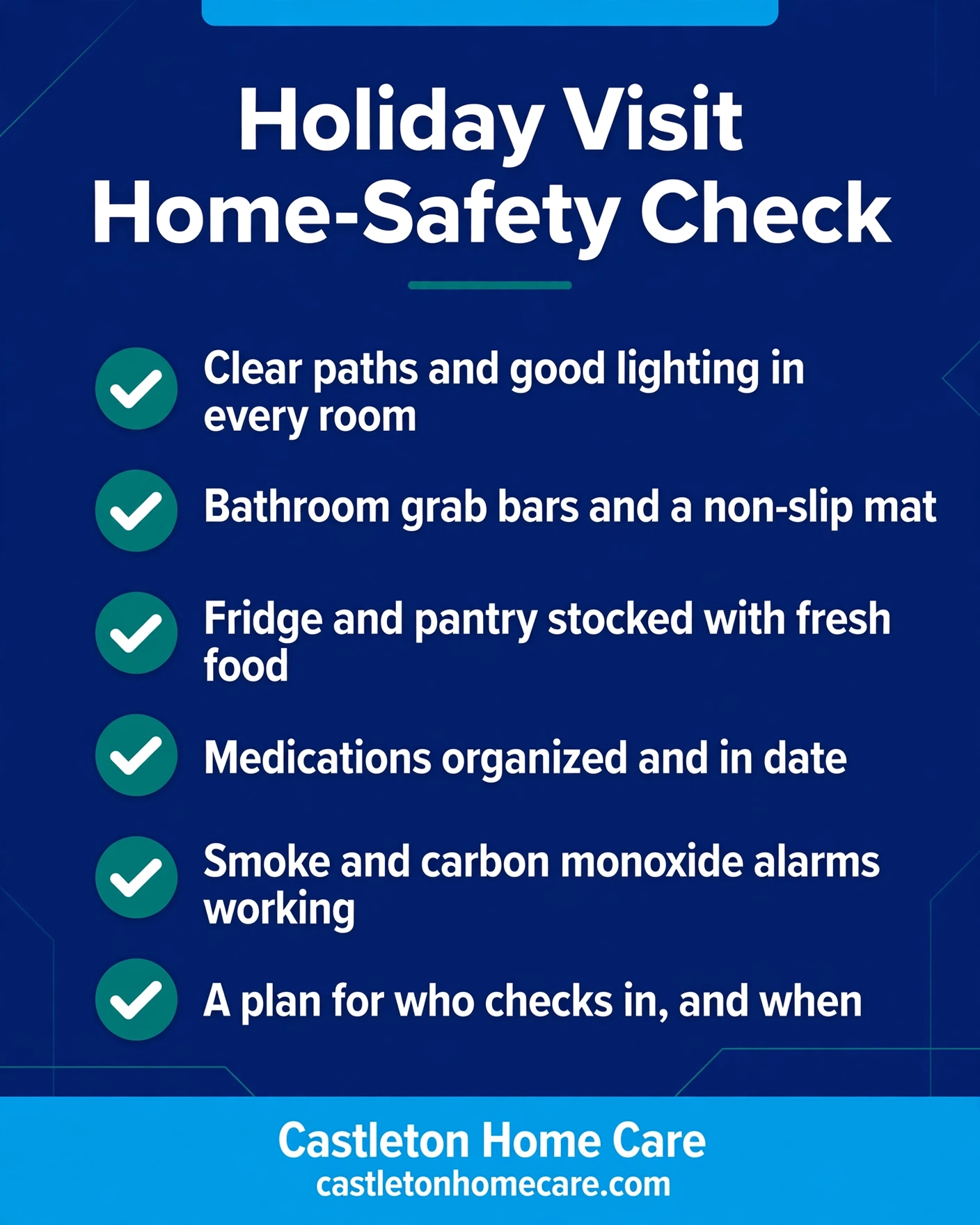
- Clear paths and good lighting in every room, especially the hallway to the bathroom. Small changes here reduce fall risks more than anything else you can do in a day.
- Bathroom grab bars and a non-slip mat. The bathroom is where most home falls happen.
- Fridge and pantry stocked with fresh food, and expired items thrown out.
- Medications organized and in date, with the list somewhere easy to find. Our caregivers give medication reminders, a prompt at the right time, every time.
- Smoke and carbon monoxide alarms working, with fresh batteries.
- A plan for who checks in, and when. Write it down. A plan that lives in one person's head is not a plan.
If you find things that need fixing, you don't have to fix them all in one visit. Start with the path to the bathroom and the lighting, and work outward from there.
Frequently Asked Questions
Can we arrange care just for the holiday week?
Short-term help for the holiday week is possible, and it works best when it is part of a routine schedule rather than a one-off visit from a stranger. For new families, the usual path is a free consultation and an in-home assessment now, which sets up a steady schedule that covers the holidays and continues past them, with the same caregiver team your parent already knows.
What should we do if we notice changes during our holiday visit?
Talk about it before everyone leaves. Compare notes with your siblings, and have an honest conversation with your parent about what you noticed and what help might look like. Then call us for a free consultation. The holidays are when most families first see the change clearly, and January is when most families wish they had acted on it.
How far ahead should we book holiday coverage?
As early as you can. Caregivers have their own holiday plans, and the families who call in October and early November get the schedule they actually want. If you're reading this in the holiday week itself, still call: we will always tell you honestly what we can do.
Getting Started
If the holidays are coming and you're thinking about your parent more than usual, trust that instinct. Call Castleton Home Care at 770-810-5974 for a free consultation. You'll talk directly with John, our owner, about what you noticed and what the holidays look like for your family. Then our registered nurse will schedule an in-home assessment, and we'll build a plan that covers the season and the months after it.
You can also reach us through our contact form. If cost is part of the question, visit our pricing page, answer three quick questions, and get your pricing range instantly. When we get in touch, we'll take the time to personally understand your unique situation and offer solutions that fit.
Sources
- AARP, "Home and Community Preferences" survey (77% of adults 50+ want to remain at home)
Disclaimer: The information in this article is provided for general educational and informational purposes only and is not intended as, and should not be taken as, medical, nursing, legal, financial, tax, or insurance advice. You should consult with qualified professionals—including, but not limited to, a doctor, attorney, financial planner, or tax advisor—for guidance specific to your situation. Castleton Home Care does not guarantee the accuracy, completeness, or timeliness of the information contained in this article and assumes no liability for any actions taken based on its contents.