

You've noticed the signs. The fridge has expired food. The laundry is piling up. Dad got lost driving a route he's known for twenty years, or Mom fell and didn't tell anyone for two days. You know your parent needs help at home — and you also know that bringing it up might start the biggest fight you've had in years.
If that's where you are, you're not alone. At Castleton Home Care, we talk to families across Alpharetta, Roswell, Cumming, and the surrounding North Metro Atlanta suburbs every week who are stuck in exactly this spot. They can see their parent needs support, but the parent won't hear of it. "I'm fine." "I don't need a stranger in my house." "Don't you dare put me in a home."
Here's the truth most families eventually learn: the conversation usually goes better than they feared — when it's handled the right way. This guide walks you through how to talk to your aging parent about home care without it turning into a battle, including what to say, when to say it, and what to do when the answer is still no.
Before you plan what to say, it helps to understand what your parent is actually hearing when you bring up home care. For most older adults, the topic isn't really about a caregiver. It's about what the caregiver represents.
Independence is identity. Your parent has run their own household for decades. Accepting help can feel like admitting they're no longer capable — and that's a grief all its own. When they say "I'm fine," they may be defending the person they've always been.
Fear is driving the resistance. Many seniors equate "home care" with "nursing home." They worry a caregiver is the first step toward losing their home, their privacy, or control over their own life. Others fear being a burden, or worry about the cost.
Role reversal stings. The parent who raised you, paid the bills, and fixed everything is now being told — by their child — that they can't manage. That dynamic shift is uncomfortable for both of you, and it can make even gentle suggestions feel like criticism.
Understanding this changes your approach completely. You're not trying to win an argument. You're trying to help someone you love accept support while protecting their dignity. Everything below is built around that goal.
The single biggest mistake families make is waiting for a crisis — a fall, a hospitalization, a scary incident — to force the conversation. Crisis conversations are rushed, emotional, and full of pressure. Your parent feels ambushed, you feel panicked, and nobody is making their best decisions.
Have the conversation while things are still relatively calm. Look for early, concrete signs that help is needed:
Choose a relaxed, private moment — not a holiday dinner, not right after a scary incident, not in front of the grandkids. A quiet afternoon at their kitchen table, over coffee, is ideal. And plan for this to be the first of several conversations, not a one-time pitch.
Two things to sort out before the conversation happens.
First, align with your siblings. Nothing derails the talk faster than one sibling pushing for help while another tells Mom "you're doing great, don't listen to them." Get on the same page first — privately. Agree on what you've observed, what you're proposing, and who will say what. Present a united, calm front, not a family debate.
Second, gather specifics, not generalizations. "You can't take care of yourself anymore" starts a fight. "I noticed the pill bottles were mixed up on Tuesday, and I'm worried" starts a conversation. Write down two or three specific observations. Facts are much harder to argue with than judgments — and they show this comes from attention, not assumption.
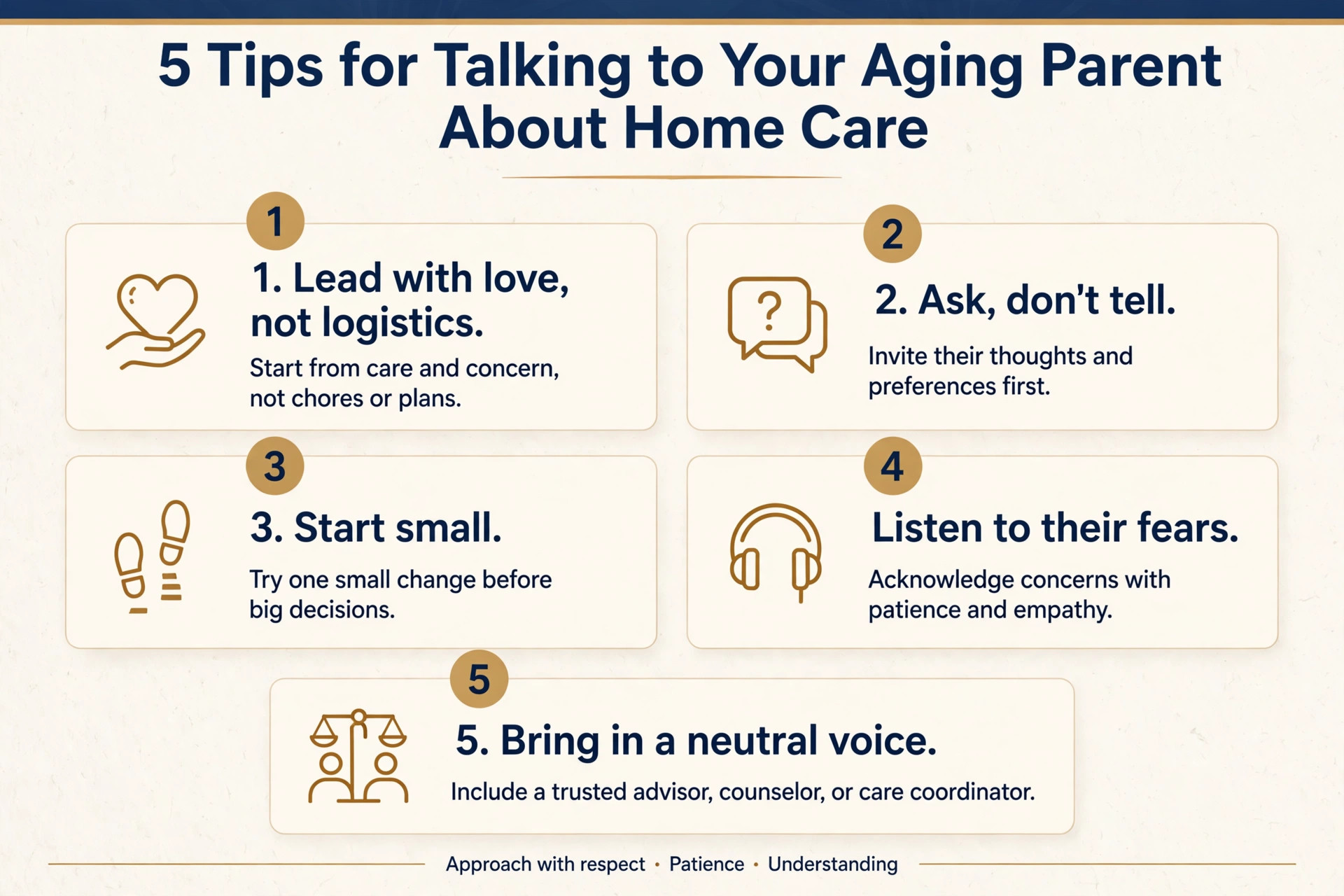
Don't open with schedules, costs, or agency brochures. Open with how you feel. "Mom, I love you, and I've been worrying about you" lands completely differently than "We need to get you some help." The first says I care about you. The second says you're a problem to solve. Start from care and concern, not chores and plans.
Questions give your parent control; statements take it away. Instead of "You need someone here during the day," try "What parts of the day feel hardest for you right now?" or "If you could wave a magic wand and get help with one thing around the house, what would it be?" You might be surprised — many parents will name the exact help they need once they're invited to, rather than told to.
The idea of "a caregiver" can feel enormous and permanent. The idea of "someone to help with laundry and groceries twice a week" feels manageable. Propose a trial: a few hours a week, for a month, focused on the least threatening tasks — housekeeping, errands, meal prep, companionship. Frame it as an experiment, not a life sentence. Once a parent experiences good help, resistance usually melts. Almost every family we work with tells us the same thing: "I wish we'd started sooner."
When your parent objects, don't argue — get curious. "I don't want a stranger in my house" might mean they're afraid of theft, or embarrassment about the state of the house, or losing privacy. Each of those fears has a real answer: caregivers are background-checked and supervised; they've seen every kind of home and judge none of them; schedules can be built around your parent's routines. You can't address the fear until you hear it. So ask: "What worries you most about the idea?" — and then just listen.
Sometimes the messenger matters more than the message. A suggestion from a trusted doctor, a longtime friend, a faith leader — or a professional care coordinator — can succeed where a child's plea fails. It removes the parent-child power dynamic entirely. Many families find that a free in-home consultation with a home care agency breaks the logjam: it's a no-pressure conversation with a professional, not a family confrontation.
Small wording choices make a big difference. A few swaps that tend to work:
Notice the pattern: every effective version preserves your parent's autonomy. That's not a trick — it's the point. Home care works best when the person receiving it has chosen it.
Sometimes you do everything right and your parent still refuses. That's painful, but it's not the end of the story. A few things to keep in mind:
Respect their autonomy — up to the safety line. Your parent is an adult with the right to make their own decisions, including decisions you disagree with. As long as they're cognitively capable and not in immediate danger, you can't force the issue — and trying will only damage trust.
Plant the seed and revisit. "Okay, I hear you. Can we talk about it again in a month?" Many parents who refuse in January agree by March, once the idea has had time to settle and the difficulties haven't gone away.
Suggest the smallest possible yes. Not a caregiver — a housekeeper. Not daily help — a ride to the doctor. A foot in the door often leads to more.
Watch for the safety line. If your parent is unsafe — leaving the stove on, wandering, unable to get up after a fall, showing signs of serious cognitive decline — that's a different conversation, and you may need to involve their doctor, an elder law attorney, or adult protective services. Refusing help is a right; being in danger is a problem that needs addressing.
Family conflict is the silent killer of good care plans. The sibling who lives far away thinks everything is fine; the one nearby is drowning. Old dynamics resurface. To keep the family functional:
You don't have to carry this alone. A professional assessment can do what family conversations sometimes can't: give everyone — including your parent — an objective picture of what's needed and what's possible.
At Castleton Home Care, our free consultations are designed exactly for this moment. A care coordinator meets with your family — at home or virtually — listens to everyone's concerns, and lays out realistic options with no pressure and no obligation. Often, hearing it from a neutral professional is what finally moves things forward. And if your parent agrees to a trial, we handle everything: matching a compatible caregiver, building the schedule around their routines, and adjusting as needs change.
If your family is anywhere in our North Metro Atlanta service area — Alpharetta, Roswell, Cumming, Johns Creek, Milton, Sandy Springs, Duluth, Suwanee, Dunwoody, or Norcross — we'd be glad to help you think it through. Call us at 770-810-5974, visit castletonhomecare.com, or email office@castletonhomecare.com. There's no obligation, and most inquiries get a same-day callback.
Bringing up home care with your aging parent is one of the hardest conversations you'll ever have — and one of the most loving. You're not trying to take something away from them. You're trying to give them more good years, safely, in the home they love, with their dignity intact.
Lead with love. Ask more than you tell. Start small. Listen longer than feels necessary. And remember: you're not asking them to give up their independence. You're offering them the support that protects it.
Disclaimer: The information in this article is provided for general educational and informational purposes only and is not intended as, and should not be taken as, medical, nursing, legal, financial, tax, or insurance advice. You should consult with qualified professionals—including, but not limited to, a doctor, attorney, financial planner, or tax advisor—for guidance specific to your situation. Castleton Home Care does not guarantee the accuracy, completeness, or timeliness of the information contained in this article and assumes no liability for any actions taken based on its contents.
.avif)
%2520(1).jpeg)
John Britt, CNA, is the owner and administrator of Castleton Home Care, an independent, non‑franchise in‑home senior care agency serving Alpharetta and North Metro Atlanta. Drawing on formal training as a certified nursing assistant and his experience providing direct hands‑on care in private homes and his local community, he now oversees care quality standards, caregiver recruitment and training, and individualized care planning for older adults who want to age in place safely at home.
John has worked closely with seniors, families, home health nurses, and local senior living communities to coordinate post‑hospital care, support chronic condition management at home, and navigate transitions between home care, assisted living, memory care, and skilled nursing facilities. His practical, evidence‑informed approach emphasizes clear communication, realistic expectations, and care plans that protect safety while preserving dignity, independence, and personal preferences.
As a lifelong Metro Atlanta resident, John is deeply familiar with local healthcare and senior care resources in Alpharetta, Johns Creek, Roswell, Milton, Cumming, and surrounding communities. He regularly shares guidance on aging in place, choosing and managing home care, and comparing local senior care options through educational articles, informative videos, caregiver training, and community outreach so families can make informed, confident decisions.
By clicking "Subscribe Now," you agree to receive periodic emails from Castleton Home Care with updates, news, and special offers. Your information will be processed in accordance with our Privacy Policy. You can unsubscribe at any time.
Subscribe to be updated when new educational videos, local expert interviews, and other written tips and guides for family caregivers are released.