
Why Nights Are the Hardest Part
Daytime is when the family is around, the phone is answered, and the house is busy. Night is when the house goes quiet, the lights go out, and every worry gets louder. Your parent is alone in the dark, getting up to use the bathroom, half awake and unsteady on their feet. You are in your own bed, phone on the nightstand, wondering whether tonight is the night something happens.
That worry is not irrational. About 1 in 4 adults 65 and older fall each year, more than 14 million people, and falls are the leading cause of injury in that age group, according to the Centers for Disease Control and Prevention. A quarter of falls at home happen in the bedroom, often on the way to or from the bathroom at night. Older adults also sleep differently than they used to: lighter, shorter stretches, waking more often, according to the National Institute on Aging. A parent who was fine at dinner can be disoriented and unsteady at 2 a.m.
Overnight care is the answer families land on when the days are manageable but the nights are not. It means a trained caregiver is in the home through the night, attentive and ready to help as needed, so your parent is never alone when the house is dark and quiet, and you can sleep knowing someone is there. This guide explains what overnight care in Johns Creek actually looks like, who it helps most, and how families start it. You can also read about overnight care from Castleton Home Care.
What Overnight Care Actually Looks Like
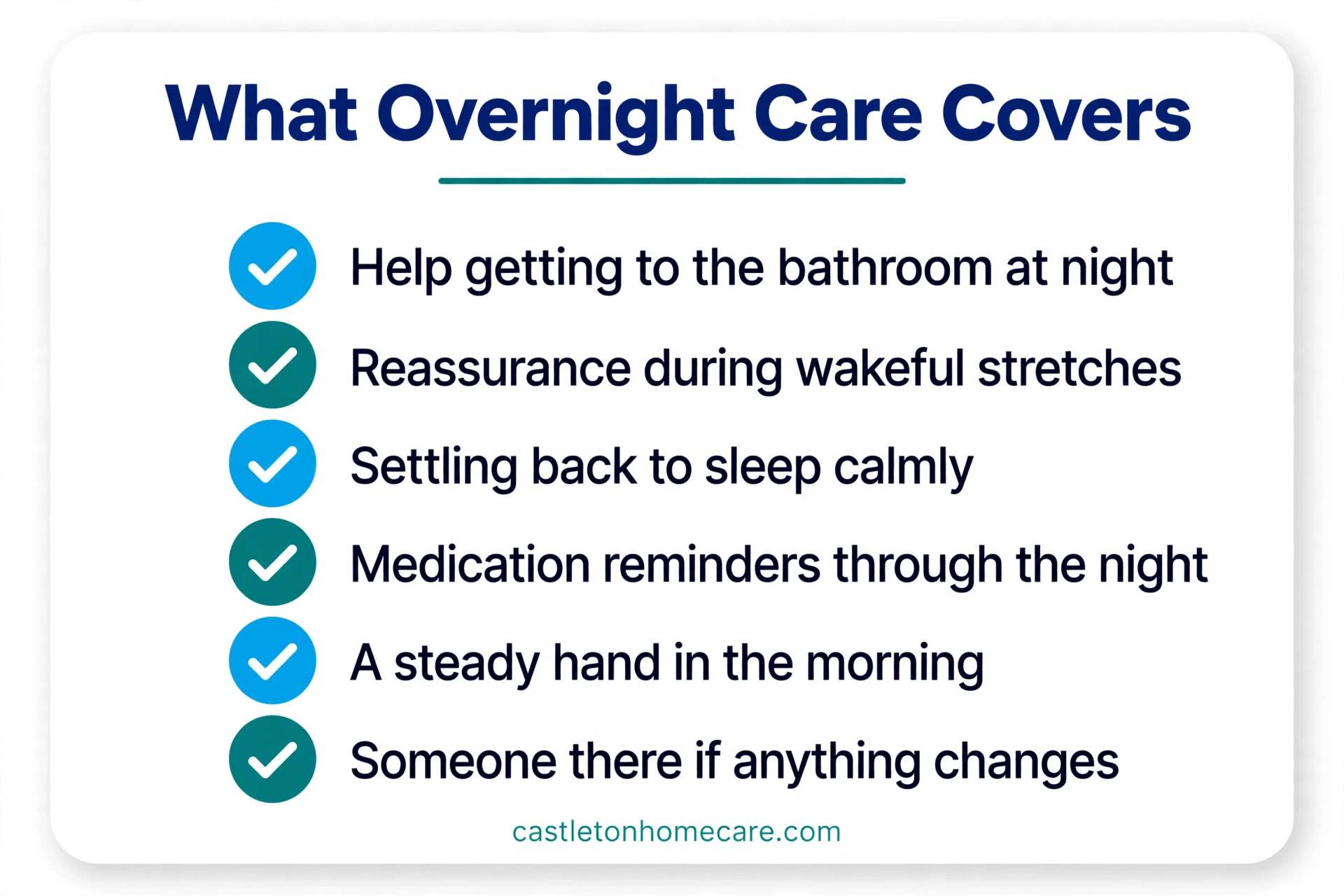
Overnight care is not a nurse sitting by the bed, and it is not a stranger sleeping on the couch. It is a professional caregiver who knows your parent, knows the house, and knows the plan for the night. Here is what that covers.
A caregiver who is there, not just on call
The difference between overnight care and a medical alert button is presence. A button helps after something happens. A caregiver is already there when it happens, and often before it does, because they know your parent gets up around midnight and again near dawn. They are attentive and ready to help as needed throughout the night, and they know the layout of the house, the creaky step, the rug that catches a toe, the bathroom light that needs switching on.
Bathroom trips and safe movement at night
The most common reason a parent gets up at night is the bathroom, and the bathroom trip is the riskiest part of the night. The caregiver helps your parent sit up, stand, walk to the bathroom, and settle back into bed, with a steady hand and a clear path. That simple help reduces the risk of a fall at night more than any single device, because the riskiest moment has a person in it.
Settling back to sleep
Some parents wake and cannot get back to sleep. They are restless, worried, or confused about the time, and a dark, empty house makes it worse. The caregiver offers a glass of water, a calm word, a familiar routine, and the quiet reassurance of another person nearby. Many families tell us this is the part they did not expect to matter so much: their parent sleeps better simply because someone is there.
Medication reminders through the night
Some medications are scheduled for the evening or the early morning, and some parents need a reminder at a set time overnight. Our caregivers give medication reminders only, at the times the care plan sets out, and note that the reminder was given. They never administer medication, and they never track, log, or verify doses. Reminders are part of the routine, the same as during the day.
The morning handoff
The night ends with a steady start to the day. The caregiver helps your parent up, helps with dressing and breakfast, and makes sure the morning routine happens safely and calmly. For families whose daytime caregiver arrives later, that handoff is the bridge: the night caregiver leaves notes about how the night went, so nothing gets lost between shifts.
Who Overnight Care Helps Most
Overnight care is not for every family, and it is not a first step for every parent. It is for the situations where the night is the problem.
- Parents with memory changes. When memory changes make a parent unsure of the time, the house, or where the bathroom is, nights get confusing and unsafe. A familiar caregiver in the home turns a frightening wake-up into a calm one.
- Parents who get up often at night. Some parents are up three or four times a night. A spouse or adult child cannot keep that pace and work the next day, and a caregiver can.
- Parents coming home after a hospital stay. The first nights home after a hospital stay are often the hardest: new medications, new routines, a body that is weaker than it was. Overnight care gives the family a safe bridge through those first weeks while strength comes back.
- Adult children who lie awake worrying. Sometimes the parent is mostly fine, but the adult child is not. If you are checking your phone at 3 a.m. or driving over after a bad feeling, overnight care is for you as much as for your parent. It gives you your sleep back.
- Spouses who need a night off. A husband or wife who has been the nighttime caregiver for months is running on empty. Overnight care lets them rest, which is what keeps them able to care during the day.
Overnight Care vs. Other Options
Overnight care vs. 24-hour care
Overnight care covers the night hours, usually as part of a broader schedule that includes daytime shifts. 24-hour care means coordinated caregiver shifts around the clock, with several caregivers covering the full day. Most families who use overnight care do so as part of a steady, ongoing routine, often alongside daytime help, rather than as a standalone service. If your parent needs help through the day and the night, the schedule and the written quote come from the in-home assessment.
Overnight care vs. a medical alert button
A medical alert button is a good tool, and many families keep one even with a caregiver in the home. But a button only works if your parent is awake enough to press it, remembers it is there, and is wearing it. A caregiver notices the restlessness before the fall, helps with the bathroom trip before the stumble, and is there for the moments a button cannot see. The two work well together. Neither replaces the other.
Overnight care vs. moving to assisted living
Moving is a big decision, and it is not the only way to get help at night. An assisted living community has staff overnight, but only limited aide time per resident, so a parent who needs help several times a night may still wait, and may still need home care on top of the facility bill. Overnight care at home keeps your parent in their own bed, in their own house, with one-on-one attention a facility cannot match. For families who want their parent to stay in Johns Creek, in the home they know, overnight care is often the simpler answer.
What a Night With a Castleton Caregiver Looks Like
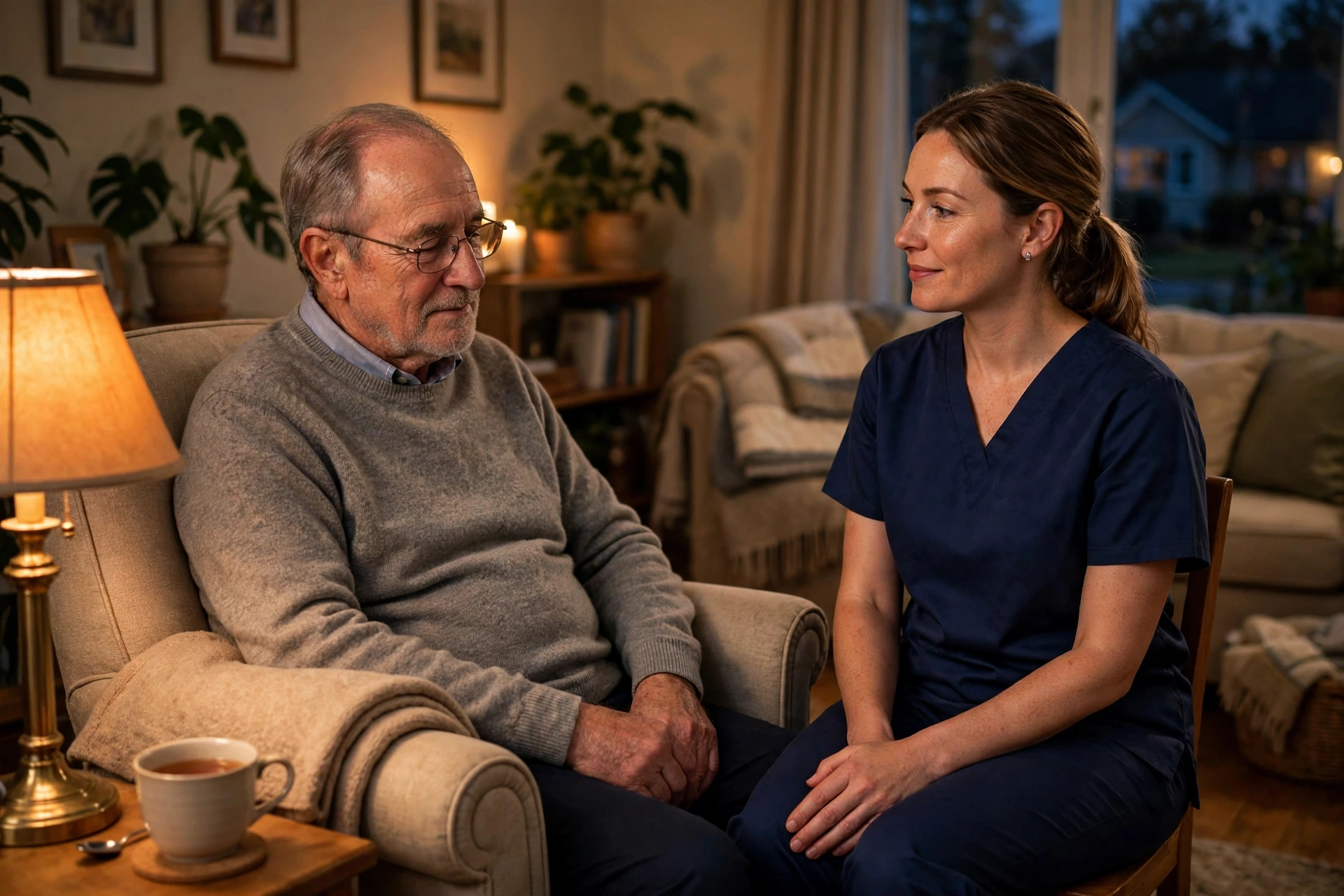
Every family is different, but a typical night follows a familiar rhythm. The caregiver arrives in the evening and settles in while your parent is still up, sharing a cup of tea or helping with the evening routine. They check that the path to the bathroom is clear, the night-lights are on, and the morning medications are set out for reminders. When your parent goes to bed, the caregiver stays nearby, attentive and ready to help as needed throughout the night.
Through the night, the caregiver helps with bathroom trips, offers water, and settles your parent back to sleep. In the morning, they help your parent up, help with dressing and breakfast, and leave notes about how the night went. If anything changes during the night, a fever, a fall, unusual confusion, the caregiver follows the care plan and contacts the family right away.
Our overnight caregivers are the same trained, background-checked caregivers who work our daytime shifts, supervised by our team and supported by RN oversight. Your parent sees familiar faces, not a rotating cast of strangers, and the care plan is the same one our registered nurse built during the in-home assessment.
Living in Johns Creek: Local Resources Worth Knowing
Home care does not happen in a vacuum. The hospitals, senior programs, and neighborhoods around you shape what care looks like in practice.
- Emory Johns Creek Hospital (6325 Hospital Parkway) is the hospital closest to most Johns Creek homes, with a 24-hour emergency department, and the most common discharge point for local families starting home care, including overnight care after a hospital stay (hospital page).
- Park Place at Newtown Park (3125 Old Alabama Road, 678-512-3430) is Johns Creek's senior recreation center, offering art classes, bridge, book discussions, yoga, fitness, and outings for residents 55 and older, a daytime anchor for parents whose nights need support (center page).
- Where Johns Creek seniors live: from the established neighborhoods of Newtown and Medlock Bridge to the golf community of St. Ives and the longtime homes along the Chattahoochee, many residents are aging in place in the houses they raised their families in. Johns Creek is home to about 81,988 people, and about 13.7% of them, roughly 11,200 residents, are 65 or older. That is exactly the situation home care is built for.
If you would like the wider picture of senior programs and emergency contacts in Johns Creek, our local guide collects them in one place.
Getting Started
The first step is a free consultation with John, the owner of Castleton Home Care. He will talk through where your parent lives in Johns Creek, what the nights look like now, and what kind of help you are considering. Then our registered nurse will do an in-home assessment, meet your parent, see the home, and build a care plan with the schedule your parent actually needs, including how many nights a week and what the caregiver should focus on.
Call Castleton Home Care at 770-810-5974, or reach us through our contact form. If you would like to understand pricing first, visit our pricing page, answer three quick questions, and get your pricing range instantly. When we get in touch, we will take the time to personally understand your unique situation and offer solutions that fit.
Frequently Asked Questions
Is overnight care the same as 24-hour care?
No. Overnight care covers the night hours, usually as part of a broader schedule that includes daytime shifts. 24-hour care means coordinated caregiver shifts around the clock. Both are different from having a caregiver move in, which Castleton does not offer. The right shape for your family comes from the in-home assessment.
Does the caregiver stay awake all night?
No, and that is not what overnight care is. Our overnight caregivers are attentive and ready to help as needed throughout the night. They rest when your parent rests and are right there the moment help is needed, for a bathroom trip, a wakeful stretch, or the start of the morning. What matters is that someone is in the home when help is needed, not that a caregiver sits upright in a chair all night.
How many nights a week do families usually schedule?
There is no usual number. The in-home assessment looks at how your parent sleeps, how often they get up, and what the family needs, and the schedule is built from that. Most families who use overnight care do so as part of a steady, ongoing routine rather than a one-off, and the schedule adjusts as things change.
Can overnight care start quickly after a hospital stay?
Yes. The first nights home after a hospital stay are often the hardest, and families call us from the hospital or the day of discharge. A free consultation starts the process, the registered nurse does the in-home assessment, and care begins on the schedule the assessment sets out.
What if my parent does not want a stranger in the house at night?
That is the most common worry families bring us, and it is a fair one. The answer is familiarity: your parent meets the caregiver first, the caregiver learns their routine, and the same small, consistent team covers the nights. Most parents who resist the idea at first come to value it within a week, because the nights get calmer and the days get easier. If it does not work, we talk about it honestly and adjust.
Sources
- Centers for Disease Control and Prevention, "Facts About Falls" (cdc.gov) (about 1 in 4 adults 65+ fall each year, more than 14 million people; falls are the leading cause of injury in that age group)
- Mayo Clinic-led analysis published in 2025 of bed-related fall injuries among adults 65+ (about 25% of falls at home occur in the bedroom)
- National Institute on Aging, "Sleep and Aging" (nia.nih.gov) (older adults experience lighter, shorter sleep and wake more often)
- Point2Homes, Johns Creek, GA demographics (population 81,988; 13.7% age 65+; median age 43.3)
Disclaimer: The information in this article is provided for general educational and informational purposes only and is not intended as, and should not be taken as, medical, nursing, legal, financial, tax, or insurance advice. You should consult with qualified professionals—including, but not limited to, a doctor, attorney, financial planner, or tax advisor—for guidance specific to your situation. Castleton Home Care does not guarantee the accuracy, completeness, or timeliness of the information contained in this article and assumes no liability for any actions taken based on its contents.