

The Decision Behind the Decision
Most families do not start out choosing between an agency and a private caregiver. They start out with a parent who needs help, a schedule that is getting harder to hold together, and a question that feels urgent: who can we trust in our parent's home?
The choice between a home care agency and a private caregiver is really a choice about who carries the responsibility. With an agency, the agency does. With a private hire, you do. Both paths can work. Both can fail. The difference is what happens on the hard days: the morning the caregiver calls in sick, the week a parent's needs change, the month the paperwork comes due. This guide walks through that difference honestly, so you can choose with your eyes open. If you are still weighing your options, our guide to the questions to ask before hiring a home care agency is a good companion to this one.
What an Agency Actually Does for You
An agency rate covers more than the caregiver's time. It pays for the structure around the caregiver, and that structure is what keeps care going when life gets complicated.
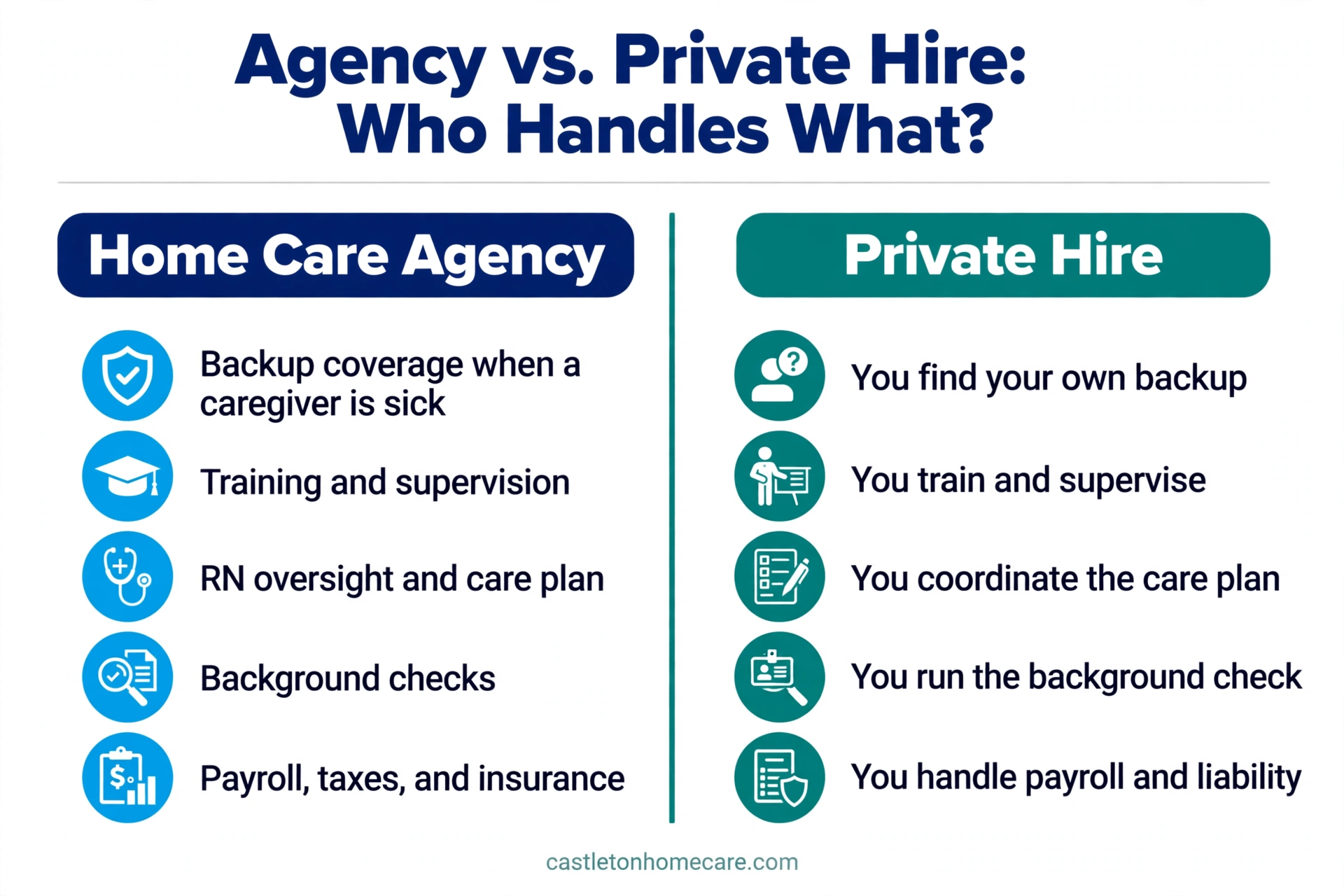
Backup coverage when a caregiver is sick
Caregivers get sick, take vacations, and have family emergencies, just like everyone else. At an agency, that is a scheduling problem the agency solves: another trained, background-checked caregiver who knows the care plan steps in. Care does not stop. This is the single biggest practical difference between an agency and a private hire, and it matters most for families who depend on steady, ongoing care. Home care has real turnover: the median caregiver turnover rate at home care agencies was 75% in 2024, according to Activated Insights, which is exactly why backup coverage exists.
Training and supervision
An agency trains its caregivers, supervises their work, and checks in on the care they provide. If a caregiver is struggling with a transfer technique or a parent's routine changes, the agency notices and corrects it. A private caregiver has no supervisor. Whatever training they arrived with is what you get, and you are the one who has to spot problems and raise them.
RN oversight and a written care plan
At Castleton, a registered nurse does an in-home assessment before care starts and builds a written care plan around your parent: what help they need, when, and how. The nurse reviews the plan as needs change and stays involved while care is running. That oversight is part of what you are paying for, and it is hard to reproduce on your own. A private caregiver can follow a plan, but someone has to write it, and that someone is usually you.
Background checks
An agency runs background checks on every caregiver before they set foot in a home, and checks credentials and references as part of hiring. When you hire privately, you run the background check yourself, or you trust a marketplace profile and hope it is complete. The check itself is not complicated, but it is one more thing on a list that is already long, and it is the kind of thing that gets skipped when a family is in a hurry.
Payroll, taxes, and insurance
An agency is the employer. It handles payroll, withholding, workers compensation, and liability insurance. When you hire privately, you become the employer. That means payroll, taxes, and insurance are yours to handle, and it means the liability sits with you. If a caregiver is hurt in your home, or if a tax filing is missed, there is no agency between you and the problem.
What Hiring Privately Really Involves
Hiring privately can work well, and some families prefer it. But it helps to see the whole job before you take it on.
You become the employer
The moment you hire a caregiver directly, you are their employer in the eyes of the law. That means a payroll schedule, tax withholding, and records. Some families handle this with a payroll service, which helps, but it is still your responsibility to set it up and keep it running. An agency takes all of that off your plate.
Finding your own backup
When a private caregiver is sick or away, there is no bench. You call around, ask friends, or go without care that day. For a parent who needs help every day, a missed shift is not an inconvenience. It is a day without bathing, without meals, without medication reminders. Families who hire privately often keep a second caregiver on standby, which means finding, vetting, and paying two people instead of one.
The costs you do not see in the hourly rate
A private caregiver's hourly rate is usually lower than an agency rate, and that is the main reason families consider it. But the rate is not the whole cost. Payroll taxes, insurance, a background check, and the time you spend managing the arrangement all add up. So does the cost of a missed shift, a caregiver who leaves without notice, or a problem that lands on you to solve. The honest comparison is not one hourly rate against another. It is the total cost of care that actually happens, week after week.
What happens when it does not work out
Sometimes the fit is wrong. The caregiver's style does not suit your parent, or the quality slips, or trust breaks down. With an agency, you call the office and the caregiver changes. With a private hire, you have the hard conversation yourself, and then you start the search again from scratch. That is a real cost, in time and in stress, and it is one families rarely budget for.
The Cost Question, Honestly
Yes, hiring privately usually costs less per hour than an agency. That is true, and any agency that tells you otherwise is not being straight with you. The question is what the lower rate buys. It buys a caregiver's time, and only their time. It does not buy backup, supervision, RN oversight, insurance, or payroll. For some families, that tradeoff is worth it. For most families who need steady, ongoing care, it is not, because the thing they are really buying is reliability: care that shows up, week after week, even when things go wrong.
If you want to see what agency care costs for your family's schedule, visit our pricing page, answer three quick questions, and get your pricing range instantly. And if your parent holds long-term care insurance, check the policy before hiring privately: many policies only reimburse care from a licensed agency, which can make the decision for you.
How to Vet Either Option
Whether you choose an agency or a private caregiver, ask the same hard questions before anyone starts.
- Who shows up when the caregiver is sick? Get a specific answer, not a reassurance. An agency should name its backup process. A private caregiver should name their backup person.
- Who wrote the care plan, and who updates it? Care without a plan drifts. Ask who assessed your parent, what the plan says, and how often it is reviewed.
- What background checks were run, and when? Ask for specifics: criminal background, references, credentials. If the answer is vague, that is your answer.
- Who is the employer, and who carries the insurance? If you are the employer, understand what that means for taxes and liability before the first shift.
- Can we meet the caregiver first? Your parent should meet the person who will be in their home, and you should see how they interact before care starts.
- What happens if it is not working? Ask how a change is handled, how quickly, and who makes the call.
These are the same questions in our guide to the questions to ask before hiring a home care agency. They apply just as well to a private hire.
When Private Hire Can Work
Private hire is not a bad choice. It can work well when a family already knows and trusts the caregiver, perhaps a neighbor, a former aide, or a friend of the family, and when someone in the family has the time and the temperament to manage the arrangement: scheduling, backup, payroll, and the hard conversations. It can also work for a short, defined need where the stakes are lower and the schedule is simple.
What private hire does poorly is the situation most North Atlanta families are actually in: a parent whose needs are growing, a schedule that needs to run for months or years, and adult children who work full time and live across town. That situation needs a system, not a single person, and a system is what an agency is.
Frequently Asked Questions
Is hiring a private caregiver cheaper than an agency?
Usually, yes, per hour. A private caregiver's hourly rate is typically lower than an agency rate, because the rate covers only their time. But the total cost is closer than the hourly rates suggest, once you add payroll taxes, insurance, background checks, and your own time managing the arrangement. And the cost of a missed shift or a caregiver who leaves is rarely counted at all. Compare the whole picture, not just the hourly number.
Will we get the same caregiver each visit?
With an agency, yes, that is the goal. At Castleton, your parent has a primary caregiver and a small, consistent, fully briefed team, so the faces stay familiar even when the primary caregiver is away. With a private hire, you have one caregiver, and when they are away, you have no one unless you arranged a backup yourself.
Who is responsible if a private caregiver gets hurt in my home?
You are, in most cases. When you hire privately, you are the employer, and the liability for a workplace injury can fall on you. An agency carries workers compensation and liability insurance, so an injury on the job is the agency's responsibility, not yours. This is worth discussing with your insurance agent before you hire.
What if the caregiver quits or gets sick?
With an agency, the agency sends a replacement, usually someone who already knows the care plan. With a private hire, you start over: finding, vetting, and training someone new, often while care is already missed. Caregiver turnover is high across the whole industry, and the home health and personal care workforce is projected to grow 17% from 2024 to 2034, with about 765,800 openings a year, according to the Bureau of Labor Statistics. That is a lot of movement, and it is the reason backup coverage matters so much.
How do I start with an agency?
Book a free consultation with John, the owner of Castleton Home Care. He will talk through where your parent lives, what kind of help they need, and what schedule you are considering. Then our registered nurse does an in-home assessment and builds a written care plan. Call Castleton Home Care at 770-810-5974, or reach us through our contact form. When we get in touch, we will take the time to personally understand your unique situation and offer solutions that fit.
Sources
- Activated Insights (Home Care Pulse), 2025 Home Care Benchmarking Study (median caregiver turnover 75% in 2024)
- U.S. Bureau of Labor Statistics, Occupational Outlook Handbook, Home Health and Personal Care Aides (projected growth 17% from 2024 to 2034; about 765,800 openings per year)
- PHI, "Direct Care Workforce Projections" (9.7 million direct care job openings from 2024 to 2034)
- AARP and National Alliance for Caregiving, "Caregiving in the U.S. 2025" (63 million family caregivers; nearly 1 in 4 provide 40 or more hours of care per week; about 1 in 3 are in the "sandwich generation")
Disclaimer: The information in this article is provided for general educational and informational purposes only and is not intended as, and should not be taken as, medical, nursing, legal, financial, tax, or insurance advice. You should consult with qualified professionals—including, but not limited to, a doctor, attorney, financial planner, or tax advisor—for guidance specific to your situation. Castleton Home Care does not guarantee the accuracy, completeness, or timeliness of the information contained in this article and assumes no liability for any actions taken based on its contents.