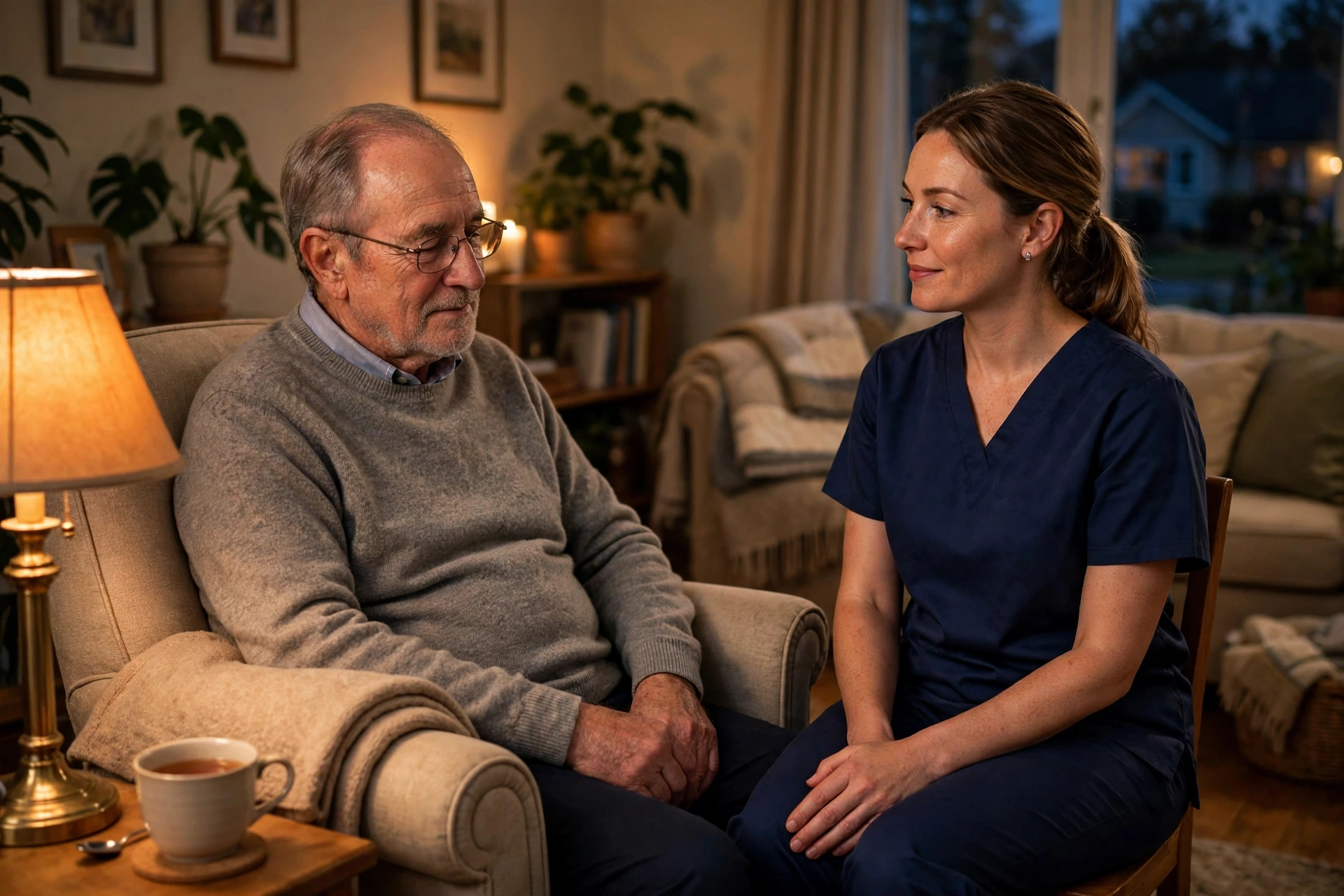

It is 11 p.m. where you live, and you are doing the math again. Mom sounded tired on the phone. The fridge was nearly empty when you visited last month. Your brother says she is fine, but he lives twenty minutes away and you live in another state, so "fine" reaches you filtered through everyone else. You cannot be there every day. The question is whether you can still make sure she is cared for every day.
You can, and millions of families do. About 63 million American adults are family caregivers, nearly one in four adults, and about 11% of those caring for an adult live an hour or more away from the person they support, according to AARP and the National Alliance for Caregiving's Caregiving in the U.S. 2025. The National Institute on Aging estimates as many as 7 million Americans are caring for a loved one from a distance. This guide is for the out-of-town adult child: how to vet a home care agency from afar, what the process actually looks like, how to build a schedule that sticks when you can't be there, and how to stay in the loop from miles away.
What Long-Distance Caregiving Actually Involves
Long-distance caregiving is mostly invisible work. It is the phone calls with the pharmacist, the bills paid online, the worry that hums in the background of your own busy life. It is also coordination: finding the right help locally, making sure it actually shows up, and staying informed enough to make good decisions from far away.
Here is the encouraging part of the data: caregivers who live apart from the person they care for are more likely to have help, both unpaid (65%, compared with 36% of those living together) and paid (39%, compared with 22%), per the same AARP and National Alliance for Caregiving report. Distance forces the issue. You cannot be the backup plan yourself, so you build a real one, and professional home care is usually the center of it.
How to Vet a Home Care Agency From Afar
You cannot drop by the office or sit in on an interview, so your vetting has to be sharper, not softer. Four checks cover most of what matters.
Check the license
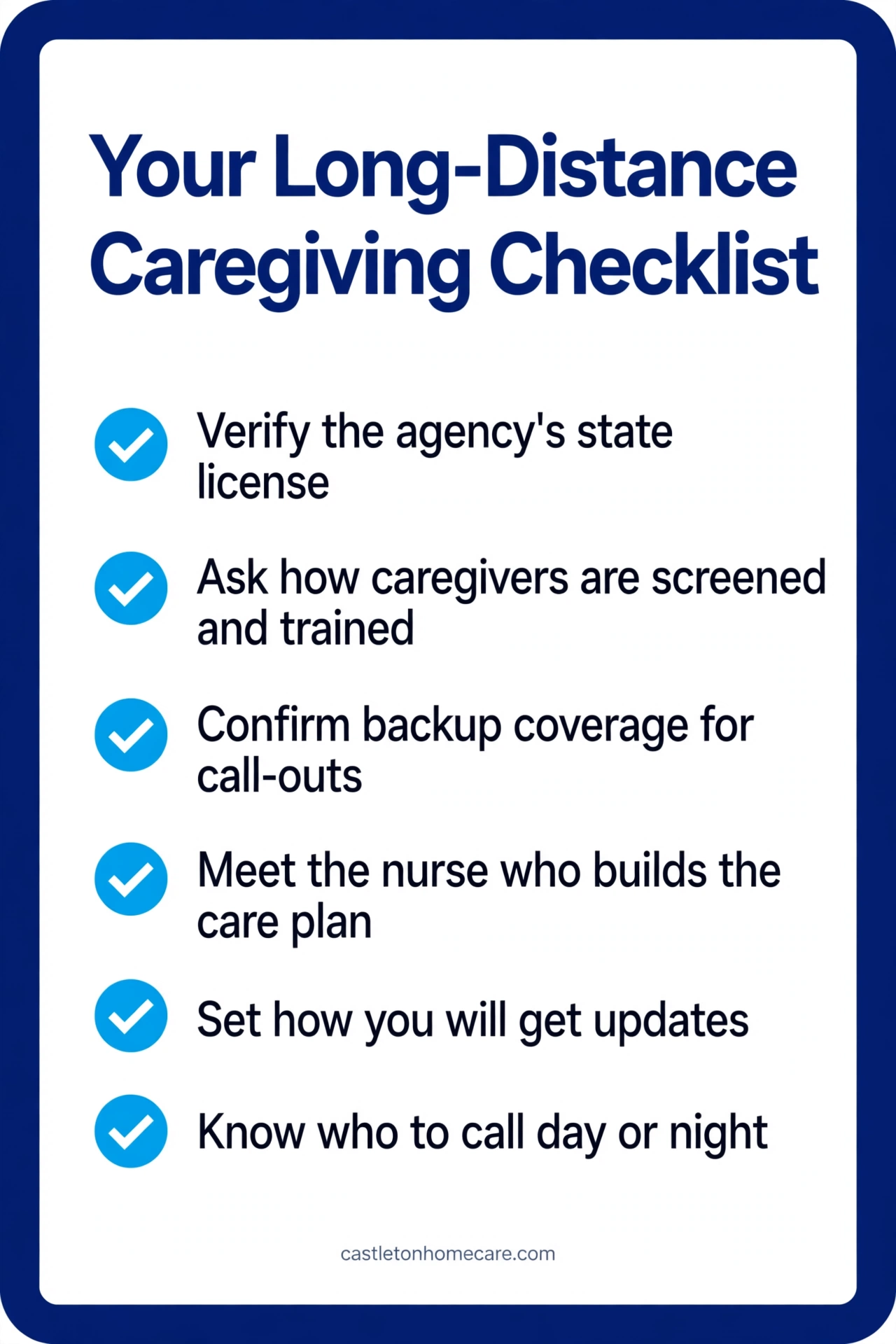
In Georgia, non-medical home care agencies are licensed by the Georgia Department of Community Health as Private Home Care Providers. Ask for the license number and look it up. A licensed agency has met state requirements for its operations; an unlicensed one is asking for your trust without the paperwork to back it. (Castleton Home Care is licensed by the Georgia DCH as a Private Home Care Provider, license number PHCP013166.)
Ask how caregivers are hired and trained
You will never meet most of the caregivers, so the agency's hiring standards are doing the trusting for you. Ask: are caregivers employees of the agency or independent contractors? What background checks are run? What training do they get before their first shift, and what ongoing training follows? Who supervises them day to day? An agency should answer all of this plainly. Vague answers are an answer.
Ask about backup coverage
This is the question distance makes critical. When a caregiver calls out sick, what happens? A real agency has a bench: a small, consistent, fully briefed team around your parent, so a call-out means a familiar backup, not a canceled visit. If the answer is some version of "we'll figure it out," keep looking. From three states away, you need a system, not a hope.
Ask who builds the care plan
A good care plan comes from someone who has been in the home and met your parent, not from a phone intake form. Ask whether a registered nurse does an in-home assessment, what the assessment covers, and how the plan gets updated as needs change. RN oversight on the care plan is one of the clearest markers of a serious agency.
The Consultation and the Assessment: What to Expect
Castleton's process has two distinct steps, and you can join both by phone or video from wherever you are.
First is a free consultation with John, the owner of Castleton Home Care. This is a conversation, not a sales pitch: where your parent lives, what a typical day looks like, what worries you most, what you have already tried. John does every consultation himself, so the person you talk to is the person accountable for what happens next.
Second is the in-home assessment with our registered nurse. She visits your parent at home, sees how they move through their day, talks with them (and with you, on the phone or video), and builds the written care plan: what kind of help, how many hours, which shifts, and what the caregiver should focus on. The assessment is what turns a worried phone call into a real plan, and it is also where your exact rate and schedule get set. When we get in touch, we'll take the time to personally understand your unique situation and offer solutions that fit.
If you are also wondering how to bring up the subject with your parent in the first place, our guide How to Talk to Your Aging Parent About Home Care (Without Starting a Fight) walks through that conversation.
Building a Schedule That Sticks
The schedule is where long-distance arrangements succeed or quietly fail. A schedule that sticks has three qualities: it is steady (same days, same times, same familiar faces), it is substantial enough to actually cover the week, and it can flex as needs change.
Most of the families we serve settle into ongoing weekly routines, often with a caregiver there most of the day, several days a week, because that is what it takes to keep a household running and a parent genuinely supported. A few scattered hours here and there does not hold up from a distance: too many gaps, too many days with no one in the house, too much falling back on you. The in-home assessment sets the starting schedule, and the RN adjusts it as things change. Your job is not to prescribe the hours; it is to describe the situation honestly so the plan matches reality.
Staying in the Loop From Miles Away
Once care starts, the worry shifts from "who will help" to "how will I know it's working." Set this up deliberately at the beginning.
Agree on how updates reach you: regular check-ins from the agency, notes from the care team, and a clear answer to "what happens if something changes." Know exactly who to call day or night, and make sure that number is in your phone before you need it. Castleton offers 24/7 on-call support, so there is always a person to reach, not a voicemail maze.
One more thing distance teaches: designate one family decision-maker if you can. When siblings are spread across states, care decisions go faster and cause less friction when one person holds the thread with the agency and keeps everyone else informed.
What It Costs
This guide will not give you a number, because an honest number depends on your parent's situation and schedule. What we can tell you is exactly how to get one: visit our pricing page, answer three quick questions, and get your pricing range instantly. Then the free consultation and the RN's in-home assessment turn that range into a written quote for your parent's actual schedule. Castleton is a private-pay agency and also works with long-term care insurance; we can walk through your policy's home care benefits with you and help with the documentation insurers require.
Frequently Asked Questions
Can I arrange everything without flying in?
Yes. The consultation happens by phone or video, the RN's in-home assessment does not require you to be there (though you can join by video), and the care plan, schedule, and billing are all handled remotely. Many of our long-distance families never set foot in the process until a regular visit home, and by then the routine is already running.
How do I know the caregiver is actually showing up?
Because the agency should be able to prove it, not just promise it. Ask how visits are verified, how you will be told about schedule changes, and what happens on a call-out. Agency-employed caregivers on a managed schedule with backup coverage look very different from an independent hire you found online and hope works out.
What if my parent resists having a stranger in the house?
That is the most common worry families bring us, and it is a fair one. The answer is familiarity, not force: your parent meets the caregiver first, the caregiver learns their routine, and the same small, consistent team covers the visits. Most parents who resist the idea at first come to value it within a few weeks, because the days get easier and the house runs better. If it does not work, we talk about it honestly and adjust. Our guide on talking to your aging parent about home care can help you start that conversation.
Who do I call in an emergency?
Us, day or night. Castleton offers 24/7 on-call support, so there is always a person to reach. Set the number up front, share it with any siblings involved, and agree with the agency in advance on what counts as "call the family immediately" versus "handle it and update us in the morning."
How do we handle the money side from another state?
The same way local families do: private pay, long-term care insurance, or a combination. Billing is handled remotely, and if your parent has a long-term care policy, we can walk through the policy's home care benefits with you and help with the documentation and visit notes insurers require for claims. We cannot tell you what a specific policy covers; that is between your family and the insurer, but we will help you know what to ask.
Sources
- AARP and the National Alliance for Caregiving, Caregiving in the U.S. 2025 (63 million American adults are family caregivers, nearly 1 in 4; about 11% of caregivers of adults live an hour or more away; caregivers living apart are more likely to have unpaid help, 65% vs. 36%, and paid help, 39% vs. 22%)
- National Institute on Aging, "Long-Distance Caregiving" (as many as 7 million Americans care for a loved one from more than an hour away)
Disclaimer: The information in this article is provided for general educational and informational purposes only and is not intended as, and should not be taken as, medical, nursing, legal, financial, tax, or insurance advice. You should consult with qualified professionals—including, but not limited to, a doctor, attorney, financial planner, or tax advisor—for guidance specific to your situation. Castleton Home Care does not guarantee the accuracy, completeness, or timeliness of the information contained in this article and assumes no liability for any actions taken based on its contents.